Energy and operations
Pump life-cycle cost: calculate beyond purchase price
When pumps differ in price and efficiency, compare annual energy, maintenance and operating hours at the same service level.
Illustrative engineering scenario · Assumptions are stated in the text.
AT A GLANCE
- Compare capital against electrical input and hours at the same duty.
- State tariff, maintenance and operating-time assumptions explicitly.
- Recalculate illustrative payback using real offers and measurements.
Compare the same service over the same period
Life-cycle cost adds electricity, service, spares, outages, installation and, where relevant, disposal to purchase price. First establish that both pumps meet the same real duty and demand profile. A catalogue family’s maximum flow and maximum head do not occur together. Efficiency is not a single peak figure; the hours spent at each flow and head matter.
Use common assumptions for electricity tariff, annual hours, service labour and study period. Calculate utility cost from electrical input kW, not motor nameplate kW or pump shaft power alone. Attributing all production losses to a pump, or omitting them entirely, can both distort a comparison. Estimate downtime separately from actual operations data if material.
Example: the cheaper purchase may cost more over five years
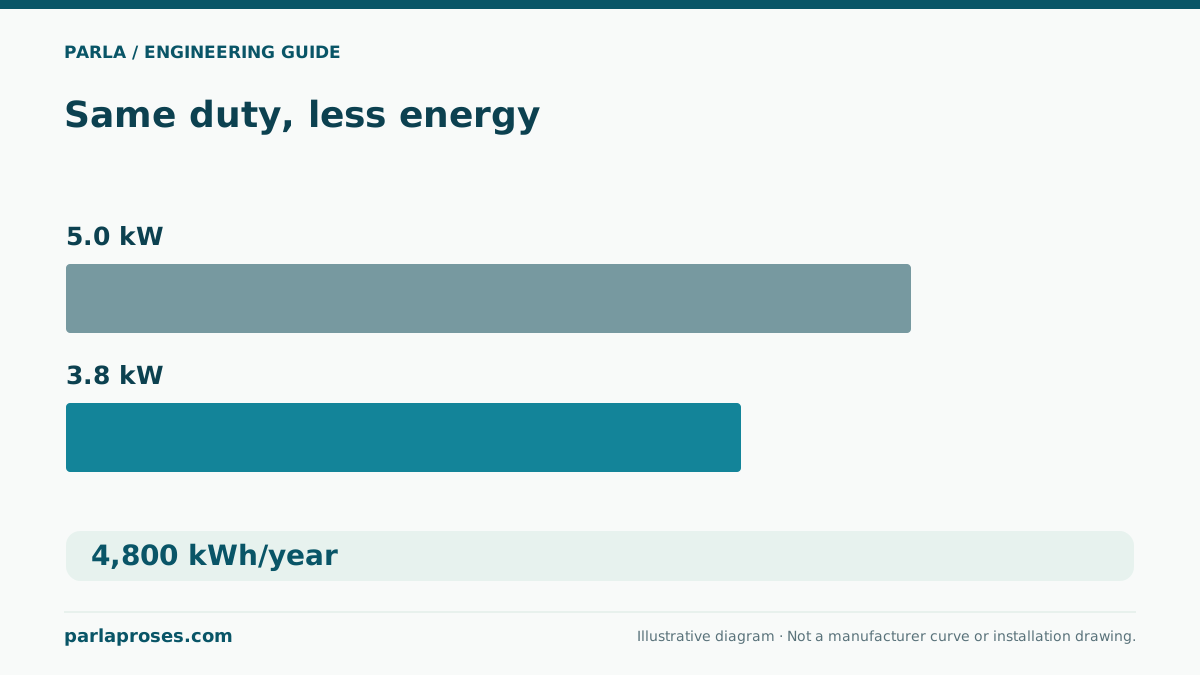
Assume two entirely illustrative alternatives provide the same flow and head. A costs TRY 40,000 initially, draws 5.5 kW electrical input at the relevant duty and incurs TRY 5,000 annual maintenance. B costs TRY 65,000, draws 4.8 kW and incurs TRY 4,000 annual maintenance. Both run 4,000 hours per year and the example holds the tariff at TRY 3/kWh. A consumes 5.5 × 4,000 = 22,000 kWh annually, costing TRY 66,000; B consumes 19,200 kWh, costing TRY 57,600.
Annual energy plus maintenance is TRY 71,000 for A and TRY 61,600 for B. Against B’s additional TRY 25,000 purchase cost, the annual difference of TRY 9,400 gives a simple payback of 25,000 / 9,400 ≈ 2.66 years. Without discounting, tariff changes or component replacements, five-year totals are TRY 40,000 + 5 × 71,000 = TRY 395,000 for A, and TRY 65,000 + 5 × 61,600 = TRY 373,000 for B. These are teaching figures, not an offer or performance guarantee.
| Item | Alternative A | Alternative B | Calculation |
|---|---|---|---|
| Capital | TRY 40,000 | TRY 65,000 | B adds TRY 25,000 |
| Annual use | 22,000 kWh | 19,200 kWh | Input kW × 4,000 h |
| Annual energy + service | TRY 71,000 | TRY 61,600 | TRY 3/kWh plus service |
| Five-year total | TRY 395,000 | TRY 373,000 | Undiscounted; other costs excluded |
Convert a load profile to annual energy
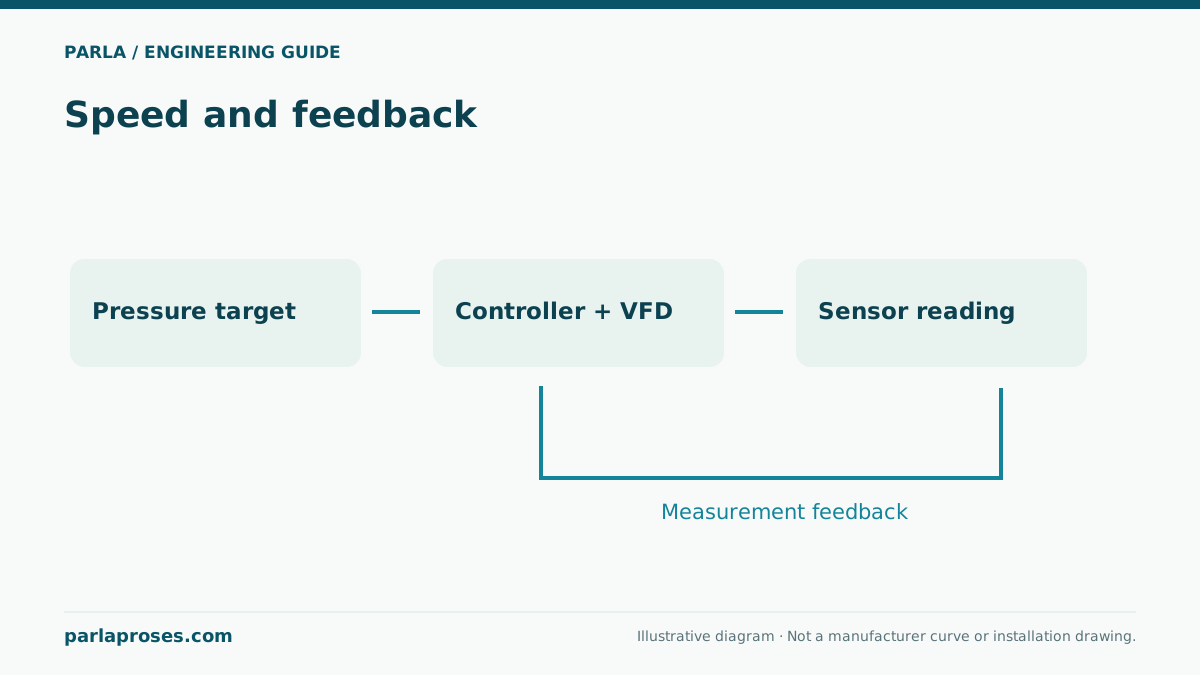
One kW measurement may not represent the entire year. For variable demand, assign hours to low, typical and high-flow periods: annual energy ≈ Σ(electrical input kW × hours in period). In a multipump booster, account for sequencing and simultaneous operation, and consider drive standby draw. Test variable-speed savings against the real system curve while maintaining required pressure.
Although the example’s power difference is 0.7 kW, at only 1,000 operating hours per year the energy difference is 700 kWh rather than 2,800 kWh, lengthening payback. Copying an energy percentage from another plant is unsound. Maintain equivalent service and comparable measurement periods when translating efficiency to cost.
Include uncertainty and service risk
Put purchase scope, foundation and installation, electrical works, spare-parts availability and planned service on the same comparison sheet. If outage costs are material, justify them with actual events and hours; do not present hypothetical production loss as a certain benefit. Discount-rate and energy-price scenarios can be added to a net-present-value analysis.
Do not select solely on the smallest five-year total. The pump must operate within its permitted range, suit the liquid and materials, and remain accessible for service. Verify results after acceptance with energy metering and maintenance work orders, then update the assumptions.
Frequently asked questions
Can annual energy cost be calculated from motor nameplate kW?+
Not directly. Use electrical input at the duty and operating hours; nameplate rating is not hourly consumption.
Are simple payback and net present value the same?+
No. Simple payback uses annual differences; NPV includes time value, discounting and yearly cash flows.
How should maintenance cost be estimated?+
Use service plans, component lives and past work orders; a supplier’s average is not a guarantee for another duty.
Should the cheapest pump never be selected?+
It may well be selected if it reliably serves the same duty and has suitable total cost. Compare initial and operating costs together.
Apply this assessment to your project.
Share your operating conditions, existing equipment and objective. Let’s assess product selection together with the technical documents.