Mixing and Process
Submersible mixer commissioning checks and acceptance criteria
A site-ready commissioning guide combining electrical, installation, level and process measurements.
Illustrative engineering scenario · Assumptions are stated in the text.
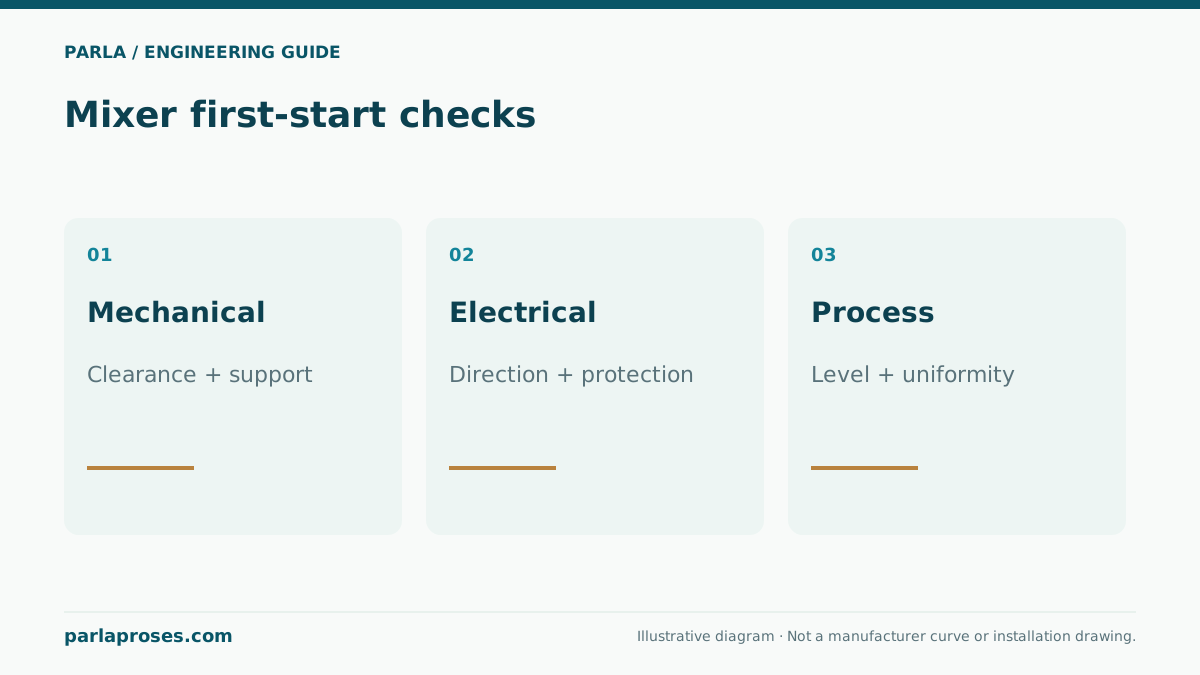
AT A GLANCE
- Complete installation and protection checks for the exact manufacturer variant.
- Interpret current alongside submergence and process outcome.
- Record settings and measurements in a reusable operator handover.
Set acceptance scope from model and process
A mixer merely running does not prove the desired tank circulation. Record model and serial number, vessel section, minimum and maximum levels, process objective, power supply and acceptance measures in the starting document. Use current manufacturer mounting dimensions and positioning advice. Defer start-up if delivered equipment and manual variant differ. Where criteria cannot be quantified, define observation method and sample points at least. A brief clean-water run alone does not prove performance in a solids-loaded process.
Complete installation and electrical checks
Check lifting capacity, rails and stops, anchors, cable support and propeller clearances. Assess collision risk with other pipework and instruments. Qualified electrical personnel check isolation, earth and panel protection before energising according to manufacturer instructions; do not apply insulation tests casually with sensitive electronics connected. Confirm rotation and phase sequence only by the manufacturer’s safe test procedure. Where seal and temperature monitoring exist, demonstrate their alarm and shutdown logic. Confined-space access follows site procedures.
Worked acceptance record: separate measurement from limit
For illustration, assume a selected variant’s manufacturer-rated current of 6.0 A and measured steady phase currents of 5.2, 5.3 and 5.1 A. Their mean is (5.2 + 5.3 + 5.1) / 3 = 5.2 A. The range is 0.2 A, about 3.8% of the mean. This small difference does not establish acceptance by itself: protection settings, voltage, manufacturer limits for the model, meter accuracy and liquid load need review. The 6.0 A is neither a real Flygt model rating nor a field measurement.
Record low-level submergence, surface vortex, sound and vibration. A normal-looking current can coexist with air entrainment near the propeller and inadequate mixing.
| Check | Example record | Acceptance approach |
|---|---|---|
| Phase currents | 5.2 / 5.3 / 5.1 A | Interpret with voltage and manufacturer limit |
| Mean current | 5.2 A | Below rating alone is insufficient |
| Low level | Measure on site | Confirm propeller and motor submergence |
| Process outcome | Multiple sample points | Compare with target homogeneity and settling |
Demonstrate circulation in the vessel
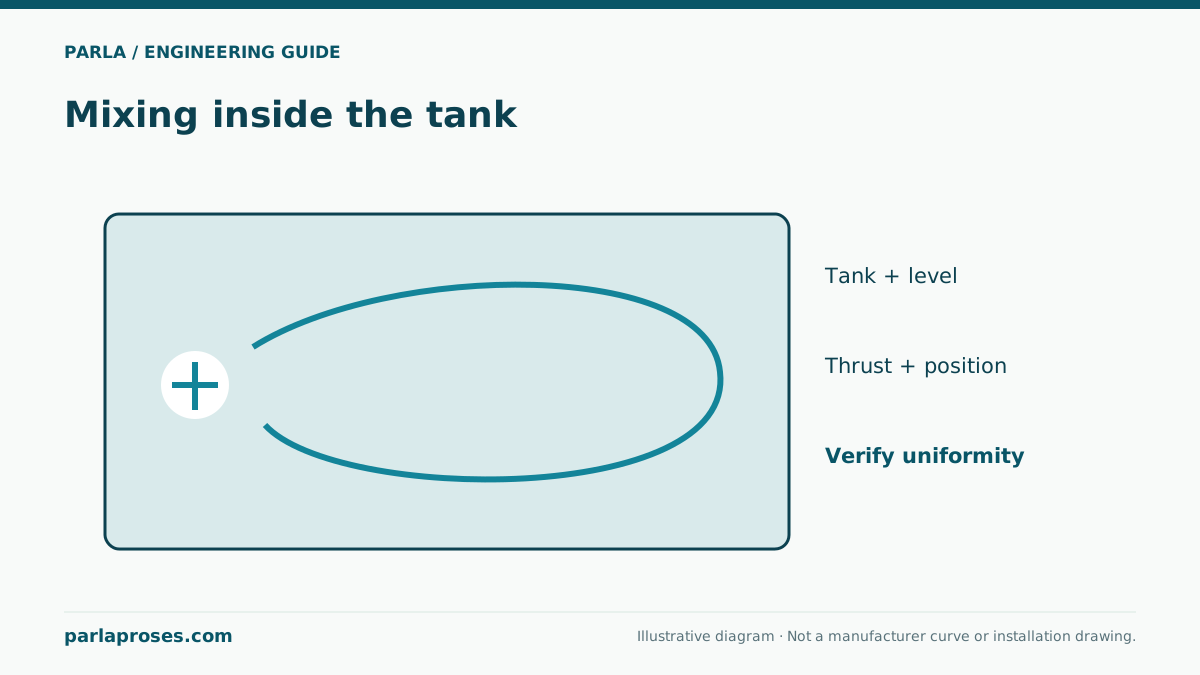
After initial operation, inspect vortices at varying levels, motion in tank corners and bottom deposition. If the process allows it, sample concentration at different locations using a safe method. Sampling immediately after switching on may precede stable circulation; define timing for the process mixing period. Record whether aeration or inlet jets are operating. Test multiple mixers individually and together. Any needed change of angle or position is made with responsible designer and manufacturer approval.
Leave a record for handover and maintenance
Handover records should include protection settings, normal current and voltage, alarms tested, water levels, orientation and position, instruments used, process samples and open items. Demonstrate seal-alarm or communication failure scenarios where present. A one-month inspection can compare sediment and energy against commissioning conditions. Put cable supports, lifting assembly and anchors into the maintenance schedule. Downloadable manufacturer manuals and data sheets help future service decisions.
Frequently asked questions
Is a mixer accepted when current is below nameplate value?+
Not on that basis alone. Check voltage, submergence, propeller orientation, process loading and manufacturer limits.
Is a short test in an empty tank enough?+
No. It may support preliminary electrical and mechanical checks but cannot validate circulation and homogeneity under liquid-loaded process conditions.
What if a surface vortex appears at low level?+
Stop and review minimum submergence and layout for the chosen model; change speed or level settings only with responsible approval.
Which process data belong in the acceptance record?+
Record location-specific concentration or sediment observations, loading and level conditions, sample timing and energy, as relevant to the objective.
Apply this assessment to your project.
Share your operating conditions, existing equipment and objective. Let’s assess product selection together with the technical documents.