Maintenance and reliability
Pump mechanical seal selection: liquid, faces and duty
Do not treat a seal leak as a replacement-parts question alone; review liquid, temperature, pressure and dry-running history.
Illustrative engineering scenario · Assumptions are stated in the text.
AT A GLANCE
- Select from liquid, temperature, pressure, solids and cycle data.
- Diagnose repeated leakage from operating logs and failure evidence, not replacement alone.
- Tie installation, venting and auxiliary arrangements to the approved product instructions.
Do not select a seal from a model code alone
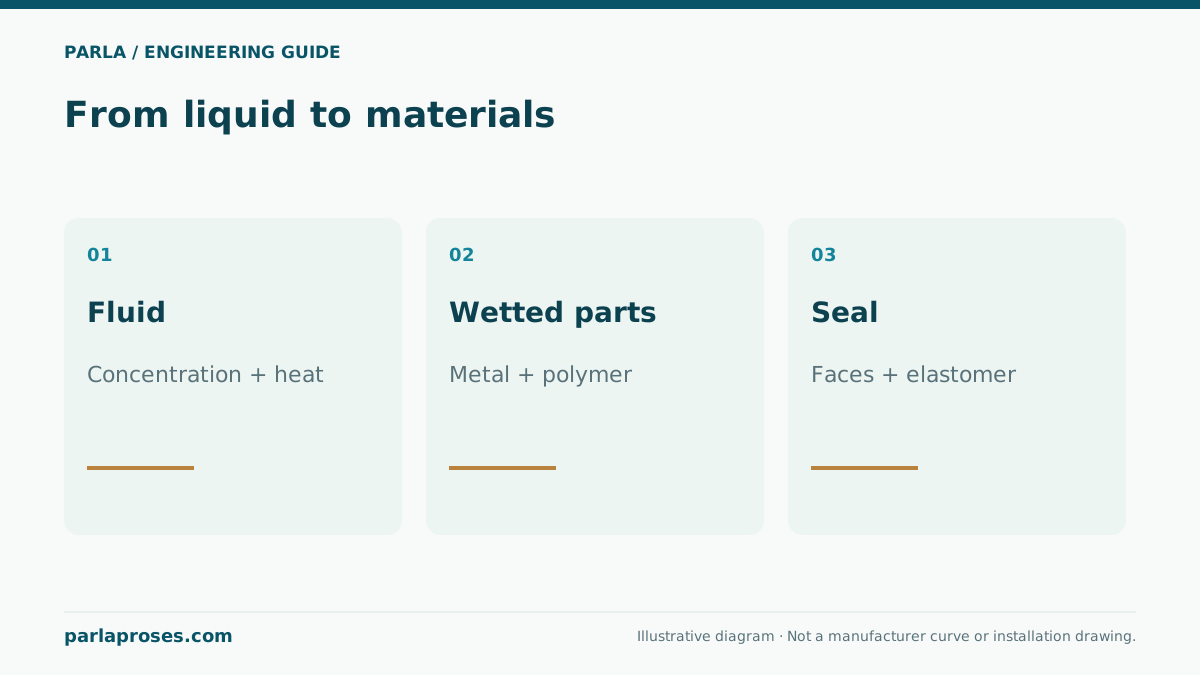
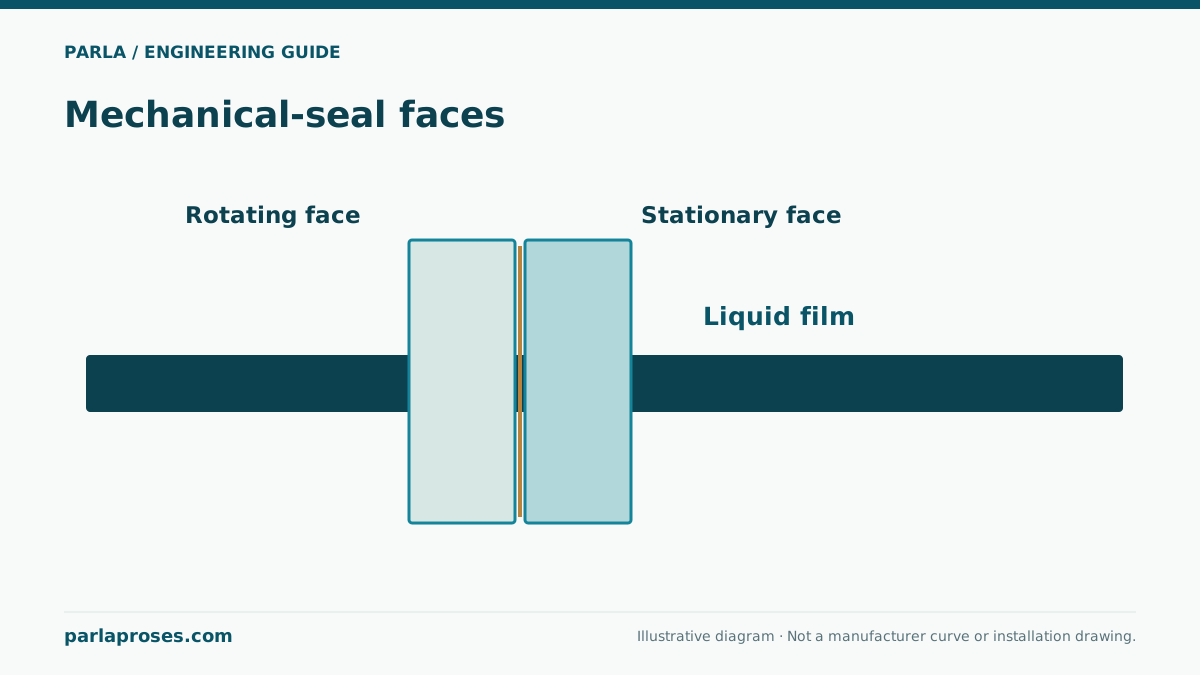
A mechanical seal needs a controlled liquid film between its rotating and stationary faces. Assess face materials, secondary elastomers, springs and metal parts together with the sealing arrangement. Temperature, pressure, viscosity, abrasive solids, crystallisation and toxicity can require different arrangements within one pump family. Starting and stopping conditions matter: running dry or with gas in the seal chamber can heat and damage the faces.
A liquid name is insufficient for an enquiry. State normal and maximum temperature, pressure and concentration, solids loading and particle properties, daily run duration, cleaning cycle and dry-running protection. Confirm the arrangement against the manufacturer’s shaft diameter, rotation and seal-chamber conditions. Assuming one face pair or elastomer suits all liquids can cause early leakage and wear.
Example: one symptom, three different causes
Assume an illustrative e-SV installation starts leaking two weeks after commissioning. The duty began with clean water at 30 °C, but a weekly cleaning cycle reaches 65 °C and the suction tank occasionally empties. Three hypotheses are possible: elastomer incompatibility at 65 °C, loss of liquid film when the tank level falls, or alignment affected by piping loads. Fitting another identical seal does not distinguish them.
Review records first: which cycle preceded the leak, did the dry-running alarm operate, and where was temperature measured? After safe isolation, inspect faces for heat marks or abrasive scoring and elastomers for deformation. Match evidence to process conditions, then select an approved seal and, where needed, revised protection with the manufacturer. This is an illustrative troubleshooting method, not a real Parla project or a guaranteed diagnosis.
| Observation | Possible mechanism | Evidence to check |
|---|---|---|
| Heat marks on faces | Insufficient film or cooling | Suction level, air, start history |
| Grooves or scoring | Particles or unsuitable face pair | Sample, strainer, solids loading |
| Swollen elastomer | Chemical or thermal incompatibility | Cleaning recipe and manufacturer limit |
| Repeated leakage | Root cause unresolved | Alignment, pipe loads, protection logs |
Assess single and dual arrangements by duty
For clean water within approved temperature and pressure limits, the manufacturer’s standard single seal may be suitable. Do not extend that assumption to abrasive, volatile, crystallising or hazardous liquids. A dual seal introduces an auxiliary fluid, monitoring and maintenance; assess possible migration of barrier or buffer fluid into the process. The arrangement name alone does not establish safe containment; the process target and manufacturer’s plan govern.
Knowing only a broad EPDM or FKM label does not fully select the secondary seal. Verify the exact part specification against the mixture, temperature and chemical cleaning range. Crystallisation on shutdown may require an approved flushing or temperature-management approach, considered within pump and piping design.
Establish film and monitoring conditions at start-up
Before starting, fill the pump, open the suction path and vent the seal chamber as instructed by the manufacturer. Remove foreign matter from connections and avoid piping loads on the pump. Log leakage and temperature during initial operation. Apparently zero visible leakage does not prove healthy face conditions in every design; interpret acceptance criteria against the specific product and service instructions.
Record the order code and installation orientation to avoid mixing material variants of the same nominal seal size. If power, vibration or bearing temperature changes alongside leakage, look beyond the seal itself. Keeping shutdown plans, spares and process safety in one record makes repeated failures easier to diagnose.
Frequently asked questions
Can a mechanical seal briefly run without water?+
Do not assume this is safe unless the manufacturer specifically allows it. Loss of film can quickly heat the faces; verify suction and protection.
Can tightening stop a seal leak?+
Follow the product’s installation instructions. Arbitrary tightening may increase face load; investigate liquid, dry running and part compatibility first.
Is an EPDM or FKM label sufficient?+
No. Verify the actual compound and liquid mixture, temperature and cleaning conditions against the manufacturer’s material schedule.
Will a dual seal solve every problem?+
No. It introduces barrier-fluid, monitoring and maintenance requirements. Suitability depends on containment goals, safety and the manufacturer’s plan.
Apply this assessment to your project.
Share your operating conditions, existing equipment and objective. Let’s assess product selection together with the technical documents.